

How To Draw Space Of Rotations
- Illustrator User Guide
- Become to know Illustrator
- Introduction to Illustrator
- What's new in Illustrator
- Common questions
- Illustrator organization requirements
- Illustrator for Apple tree silicon
- Workspace
- Workspace nuts
- Create documents
- Tools
- Default keyboard shortcuts
- Customize keyboard shortcuts
- Artboards
- Customize the workspace
- Backdrop panel
- Set preferences
- Touch Workspace
- Microsoft Surface Dial back up in Illustrator
- Recovery, undo, and automation
- Rotate view
- Rulers, grids, and guides
- Accessibility in Illustrator
- Safe Mode
- View artwork
- Utilise the Bear upon Bar with Illustrator
- Files and templates
- Synchronize settings using Adobe Creative Cloud
- Tools in Illustrator
- Option
- Overview
- Selection
- Direct Selection
- Lasso
- Artboard
- Overview
- Navigation
- Overview
- Zoom
- Rotate View
- Paint
- Overview
- Gradient
- Shape Builder
- Type
- Overview
- Blazon
- Blazon on Path
- Option
- Introduction to Illustrator
- Illustrator on the iPad
- Introduction to Illustrator on the iPad
- Illustrator on the iPad overview
- Illustrator on the iPad FAQs
- System requirements | Illustrator on the iPad
- What you can or cannot practice on Illustrator on the iPad
- Workspace
- Illustrator on the iPad workspace
- Touch shortcuts and gestures
- Keyboard shortcuts for Illustrator on the iPad
- Manage your app settings
- Documents
- Work with documents in Illustrator on the iPad
- Import Photoshop and Fresco documents
- Select and arrange objects
- Create echo objects
- Blend objects
- Drawing
- Draw and edit paths
- Describe and edit shapes
- Blazon
- Piece of work with type and fonts
- Create text designs along a path
- Add your own fonts
- Work with images
- Vectorize raster images
- Color
- Apply colors and gradients
- Introduction to Illustrator on the iPad
- Cloud documents
- Basics
- Work with Illustrator cloud documents
- Share and collaborate on Illustrator cloud documents
- Upgrade cloud storage for Adobe Illustrator
- Illustrator deject documents | Common questions
- Troubleshooting
- Troubleshoot create or save problems for Illustrator cloud documents
- Troubleshoot Illustrator cloud documents problems
- Basics
- Add and edit content
- Cartoon
- Drawing basics
- Edit paths
- Draw pixel-perfect art
- Draw with the Pen, Curvature, or Pencil tool
- Draw unproblematic lines and shapes
- Image Trace
- Simplify a path
- Define perspective grids
- Symbolism tools and symbol sets
- Adjust path segments
- Design a blossom in five like shooting fish in a barrel steps
- Perspective cartoon
- Symbols
- Draw pixel-aligned paths for spider web workflows
- 3D effects and Adobe Substance materials
- Most 3D effects in Illustrator
- Create 3D graphics
- Create 3D objects
- Create 3D Text
- Most 3D effects in Illustrator
- Color
- About color
- Select colors
- Utilise and create swatches
- Adjust colors
- Use the Adobe Colour Themes console
- Color groups (harmonies)
- Colour Themes console
- Recolor your artwork
- Painting
- Nearly painting
- Pigment with fills and strokes
- Live Paint groups
- Gradients
- Brushes
- Transparency and blending modes
- Apply stroke on an object
- Create and edit patterns
- Meshes
- Patterns
- Select and conform objects
- Select objects
- Layers
- Group and expand objects
- Move, align, and distribute objects
- Stack objects
- Lock, hide, and delete objects
- Duplicate objects
- Rotate and reverberate objects
- Reshape objects
- Ingather images
- Transform objects
- Combine objects
- Cut, divide, and trim objects
- Puppet Warp
- Calibration, shear, and distort objects
- Blend objects
- Reshape using envelopes
- Reshape objects with effects
- Build new shapes with Shaper and Shape Builder tools
- Work with Alive Corners
- Enhanced reshape workflows with touch support
- Edit clipping masks
- Live shapes
- Create shapes using the Shape Builder tool
- Global editing
- Type
- Add together text and piece of work with type objects
- Manage text area
- Fonts and typography
- Format type
- Import and export text
- Format paragraphs
- Special characters
- Create type on a path
- Character and paragraph styles
- Tabs
- Text and type
- Find missing fonts (Typekit workflow)
- Update text from Illustrator 10
- Arabic and Hebrew type
- Fonts | FAQ and troubleshooting tips
- Create 3D text effect
- Artistic typography designs
- Scale and rotate type
- Line and character spacing
- Hyphenation and line breaks
- Text enhancements
- Spelling and language dictionaries
- Format Asian characters
- Composers for Asian scripts
- Create text designs with blend objects
- Create a text poster using Prototype Trace
- Create special furnishings
- Work with effects
- Graphic styles
- Create a drib shadow
- Advent attributes
- Create sketches and mosaics
- Drop shadows, glows, and feathering
- Summary of furnishings
- Web graphics
- All-time practices for creating web graphics
- Graphs
- SVG
- Create animations
- Slices and prototype maps
- Cartoon
- Import, export, and relieve
- Import
- Import artwork files
- Import bitmap images
- Import artwork from Photoshop
- Place multiple files | Illustrator CC
- Unembed images
- Import Adobe PDF files
- Import EPS, DCS, and AutoCAD files
- Links information
- Creative Cloud Libraries in Illustrator
- Creative Deject Libraries in Illustrator
- Save
- Salve artwork
- Export
- Use Illustrator artwork in Photoshop
- Consign artwork
- Collect assets and export in batches
- Package files
- Create Adobe PDF files
- Extract CSS | Illustrator CC
- Adobe PDF options
- File information and metadata
- Import
- Printing
- Ready for printing
- Ready documents for printing
- Change the page size and orientation
- Specify ingather marks for trimming or aligning
- Get started with big canvas
- Printing
- Overprint
- Print with colour management
- PostScript printing
- Impress presets
- Printer's marks and bleeds
- Print and save transparent artwork
- Trapping
- Print color separations
- Impress gradients, meshes, and color blends
- White Overprint
- Ready for printing
- Automate tasks
- Data merge using the Variables panel
- Automation with scripts
- Automation with actions
- Troubleshooting
- Crash issues
- Recover files after crash
- File issues
- GPU device commuter issues
- Wacom device problems
- DLL file issues
- Memory issues
- Preferences file issues
- Font issues
- Printer issues
- Share crash report with Adobe
3D tools are contained of the Perspective Filigree tools and 3D objects are treated similar whatsoever other object in perspective.
Create 3D objects
3D effects enable yous to create three-dimensional (3D) objects from two-dimensional (2d) artwork. You can control the advent of 3D objects with lighting, shading, rotation, and other properties. You can also map artwork onto each surface of a 3D object.
There are ii ways to create a 3D object: past extruding or revolving. In addition, you lot can too rotate a 2D or 3D object in three dimensions. To use or modify 3D furnishings for an existing 3D object, select the object then double-click the outcome in the Appearance panel.
3D objects may brandish anti-aliasing artifacts on screen, but these artifacts won't print or announced in artwork optimized for the spider web.
For a video almost working with 3D objects in Illustrator, see Moving into the world of 3D.
Create a 3D object by extruding
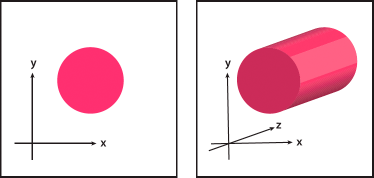
Extruding extends a 2nd object along the object'south z axis to add depth to the object. For example, if you extrude a 2D ellipse, information technology becomes a cylinder.
The object's axis always lies perpendicular to the object'southward front surface and moves relative to the object if the object is rotated in the 3D Options dialog box.
-
Click Effect > 3D(Classic) > Extrude & Bevel (Archetype).
-
Click More Options to view the consummate list of options, or Fewer Options to hide the extra options.
-
Select Preview to preview the effect in the document window.
-
Position
Sets how the object is rotated and the perspective from which you view it. (See Set 3D rotation position options.)
Extrude & Bevel
Determines the object's depth and the extent of whatever bevel added to or cut from it. (See Extrude & Bevel options.)
Surface
Creates a broad variety of surfaces, from dull and unshaded matte surfaces to glossy and highlighted surfaces that await like plastic. (See Surface shading options.)
Lighting
Adds one or more lights, varies the calorie-free intensity, changes the object's shading color, and moves lights around the object, for dramatic effects. (Encounter Lighting options.)
Map
Maps artwork onto the surfaces of a 3D object. (See Map artwork to a 3D object.)
-

Extruded object without a beveled edge (left) compared to object with Bevel Extent In (middle) and with Bevel Extent Out (correct)
Create a 3D object by revolving
Revolving sweeps a path or profile in a circular direction around the global y axis (revolve axis) to create a 3D object. Because the revolve axis is vertically fixed, the open up or airtight path that you lot revolve typically needs to depict half of the desired 3D object's profile in a vertical and front end-facing position; you can and then rotate the 3D object'due south position in the effect's dialog box.
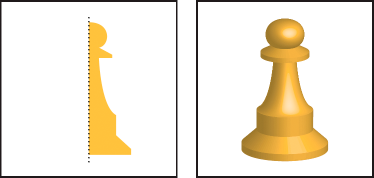
-
Applying the 3D Revolve upshot to 1 or more objects simultaneously revolves each object effectually its ain centrality. Each object resides in its ain 3D space and can't intersect other 3D objects. Applying the Circumduct effect to a targeted grouping or layer, on the other hand, revolves the objects around a single axis.
Revolving a filled path with no stroke is much faster than revolving a stroked path.
-
Click Issue > 3D(Classic) > Revolve (Classic).
-
Select Preview to preview the effect in the document window.
-
Click More than Options to view the complete list of options, or Fewer Options to hibernate the actress options.
Position
Sets how the object is rotated and the perspective from which you view information technology. (See Ready 3D rotation position options.)
Revolve
Determines how to sweep the path effectually the object to plow it into three dimensions. (Come across Revolve options.)
Surface
Creates a wide diverseness of surfaces, from wearisome and unshaded matte surfaces to glossy and highlighted surfaces that wait similar plastic. (Meet Surface shading options.)
Lighting
Adds one or more lights, varies the light intensity, changes the object's shading colour, and moves lights effectually the object, for dramatic effects. (See Lighting options.)
Map
Maps artwork onto the surfaces of a 3D object. (Run into Map artwork to a 3D object.)
Set options
Fix 3D rotation position options
-
-
Select a preset position from the Position menu.
-
For unconstrained rotation, drag a track cube face. The front of the object is represented by the rail cube's blueish face, the object's top and bottom faces are light greyness, the sides are medium gray, and the back face is nighttime gray.
-
To constrain the rotation forth a global centrality, hold downwards Shift while dragging horizontally (global y centrality) or vertically (global 10 axis). To rotate the object around the global z axis, drag in the bluish band that surrounds the rail cube.
-
To constrain the rotation around an object axis, drag an edge on the track cube. The arrow changes to a double-sided arrow
 , and the cube edge changes colour to identify the centrality around which the object will rotate. Carmine edges represent the object's x axis, dark-green edges stand for the object's y centrality, and bluish edges stand for the object's z axis.
 -
Enter values between –180 and 180 in the horizontal (x) axis
 , vertical (y) centrality
 , and depth (z) axis
 text boxes.
 -
To conform the perspective, enter a value between 0 and 160 in the Perspective text box. A smaller bending is like to a telephoto camera lens; a larger lens angle is like to a broad-angle camera lens.
-
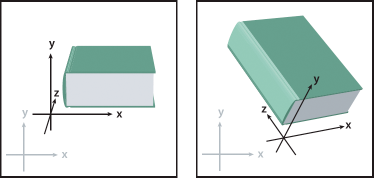
A lens bending that is college than 150 may issue in objects extending across your betoken of view and actualization distorted. Also, keep in mind that there are object ten, y, and z axes and global x, y, and z axes. Object axes remain relative to an object'south position in its 3D space. Global axes remain fixed relative to the computer screen; the 10 centrality lies horizontally, the y axis lies vertically, and the z axis lies perpendicular to the computer screen.
Extrude & Bevel options
Extrude Depth
Sets the depth of the object, using a value between 0 and 2000.
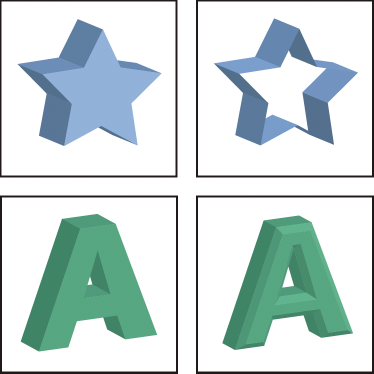
Cap
Specifies whether the object appears solid (Revolve Cap On ) or hollow (Revolve Cap Off
 ).
).
Bevel
Applies the type of askew edge you choose along the depth (z axis) of the object.
Height
Sets the tiptop between ane and 100. Bevel heights that are too big for an object may cause the object to self-intersect and produce unexpected results.
Bevel Extent Out

Adds the bevel to the object'southward original shape.
Bevel Extent In

Carves the bevel out of the object's original shape.
Revolve options
Angle
Sets the number of degrees to revolve the path, between 0 and 360.
Cap
Specifies whether the object appears solid (Revolve Cap On) or hollow (Circumduct Cap Off).
Offset
Adds altitude betwixt the revolve axis and the path, to create a ring-shaped object, for instance. You tin enter a value between 0 and 1000.
From
Sets the axis around which the object revolves, either the Left Edge or Right Edge.
Surface shading options
Surface
Lets y'all choose options for the shading surfaces:
Wireframe
Outlines the contours of the object's geometry and makes each surface transparent.
No Shading
Adds no new surface properties to the object. The 3D object has the same color equally the original 2D object.
Diffuse Shading
Makes the object reflect light in a soft, diffuse pattern.
Plastic Shading
Makes the object reverberate lite as if it were made of a shiny, high-gloss cloth.
note: Depending on what option you lot choose, different lighting options are available. If the object only uses the 3D Rotate effect, the only Surface choices bachelor are Diffuse Shading or No Shading.
Light Intensity
Controls the light intensity between 0% and 100%.
Ambient Light
Controls the global lighting, which changes the brightness of all the object's surfaces uniformly. Enter a value between 0% and 100%.
Highlight Intensity
Controls how much the object reflects light, with values ranging from 0% to 100%. Lower values produce a matte surface, and college values create a shinier-looking surface.
Highlight Size
Controls the size of the highlight from large (100%) to small (0%).
Alloy Steps
Controls how smoothly the shading appears across the object'southward surfaces. Enter a value betwixt 1 and 256. Higher numbers produce smoother shades and more paths than lower numbers.
Draw Hidden Faces
Displays the object's hidden backfaces. The backfaces are visible if the object is transparent, or if the object is expanded and so pulled autonomously.
Annotation: If your object has transparency and you want the hidden backfaces to display through the transparent front end faces, apply the Object > Group command to the object before yous employ the 3D result.
Preserve Spot Color (Extrude & Bevel effect, Revolve issue, and Rotate effect)
Lets you preserve spot colors in the object. Spot colors can't be preserved if you chose Custom for the Shading Color option.
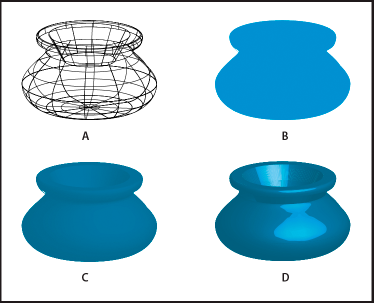
A. WireframeB. No shadingC. Lengthened shadingD. Plastic shading
Lighting options
Light

Defines where the lite is. Drag the light to where you want it on the sphere.
Motion Light Back button

Moves the selected light backside the object.
Move Light Front end push button

Moves the selected light in front of the object.
New Calorie-free push button

Adds a light. By default, new lights appear in the front end center of the sphere.
Delete Low-cal push button
Deletes the selected light.
note: By default, 3D Furnishings assigns 1 low-cal to an object. Y'all can add and delete lights, just the object must always have at least i light.
Calorie-free Intensity
Changes the selected low-cal's intensity betwixt 0% and 100%.
Shading Colour
Controls the object'southward shading colour, depending on the command you choose:
None
Adds no color to the shading.
Custom
Lets you choose a custom color. If you lot choose this option, click the Shade Color box to select a colour in the Color Picker. Spot colors are changed to process colors.
Black Overprint
Avoids process colors if you're using a spot color workflow. The object is shaded past overprinting shades of black on height of the object'due south fill colour. To view the shading, choose View >Overprint Preview.
Preserve Spot Color
Lets you preserve spot colors in the object. Spot colors can't be preserved if you chose Custom for the Shading Color selection.
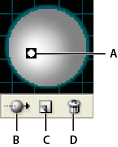
A. Selected light in frontB. Move selected calorie-free to back or front buttonC. New light buttonD. Delete lite button
Add a custom bevel path
-
Open the Bevels.ai file, which is located in the Adobe Illustrator [version]\Support Files\Required\Resources\en_US\ folder (Windows) or Adobe Illustrator [version]\Required\Resource\en_US folder ((Mac OS).
-
Create a unmarried open path in the Bevels.ai file.
-
Choose Window > Symbols, and do i of the post-obit to make the path a symbol:
-
Drag the path to the Symbols panel.
-
With the path selected, click the New Symbol push
in the Symbols panel or click New Symbol from the panel menu.
-
-
To rename the symbol, double-click the symbol in the Symbols panel, enter a name in the Symbol Options dialog box, and clickOK.
-
ClickFile > Save. If the Salve option doesn't work, clickFile > Salvage As to salve the file as a local copy to the computer. Rename the file and move it back to the original location: Adobe Illustrator [version]\Support Files\Required\Resources\en_US\ binder (Windows) or Adobe Illustrator [version]\Required\Resources\en_US binder ((Mac OS). The existing file in the original destination is replaced.
-
Quit Illustrator and relaunch the application.
The Bevel menu in the 3D Extrude & Bevel Options dialog box lists the bevel.
-
To apply the custom bevel, do one of the following:
-
To apply the bevel to an extruded 3D object, select the 3D object, and double-click the 3D Extrude & Bevel issue in the Appearance panel. In the 3D Extrude & Bevel Options dialog box, choose the bevel from the Bevel menu.
-
To apply the custom bevel to second artwork, select the 2D object, and choose Consequence > 3D > Extrude & Bevel. In the 3D Extrude & Bevel Options dialog box, cull the custom bevel from the Bevel bill of fare.
-
Rotate an object in three dimensions
-
Choose Effect > 3D(Archetype) > Rotate (Classic).
-
Select Preview to preview the effect in the document window.
-
Click More Options to view the complete list of options, or Fewer Options to hide the extra options.
-
Position
Sets how the object is rotated and the perspective from which you view it. (Encounter Set 3D rotation position options.)
Surface
Creates a wide variety of surfaces, from dull and unshaded matte surfaces to glossy and highlighted surfaces that look like plastic. (See Surface shading options.)
Map artwork to a 3D object
Every 3D object is composed of multiple surfaces. For example, an extruded square becomes a cube that is made of six surfaces: the front and dorsum faces, and the iv side faces. You can map 2D artwork to each surface on a 3D object. For case, you might want to map a label or text onto a canteen-shaped object or simply add different textures to each side of an object.
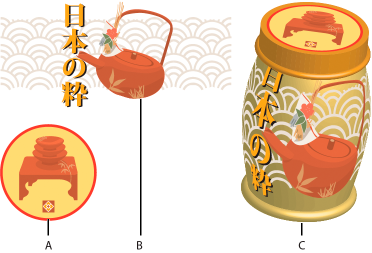
A. Symbol artworkB. Symbol artworkC. A and B mapped to 3D object
You can only map 2D artwork that's stored in the Symbols panel to a 3D object. Symbols tin be any Illustrator art object, including paths, compound paths, text, raster images, mesh objects, and groups of objects.
When mapping 3D objects, consider the following:
-
Because the Map Art feature uses symbols for mapping, you can edit a symbol instance and so automatically update all surfaces that are mapped with it.
-
You lot can collaborate with the symbol in the Map Fine art dialog box with normal bounding box controls to move, scale, or rotate the object.
-
The 3D issue remembers each mapped surface on an object as a number. If you edit the 3D object or utilize the same outcome to a new object, in that location may be fewer or more than sides than the original. If there are fewer surfaces than the number of surfaces defined for the original mapping, the extra artwork volition be ignored.
-
Considering a symbol's position is relative to the center of an object surface, if the geometry of the surface changes, then the symbol will be remapped relative to the new center of the object.
-
You can map artwork to objects that apply the Extrude & Bevel or Revolve effect, but yous can't map artwork to objects that only apply the Rotate effect.
-
In the Appearance panel, double-click the 3D Extrude & Bevel or 3D Circumduct consequence.
-
Choose the artwork to map to the selected surface from the Symbol pop‑up menu.
-
A light greyness color mark appears on the surfaces that are currently visible. A dark gray color marking appears on the surfaces that are hidden by the object'due south current position. When a surface is selected in the dialog box, the selected surface is outlined in carmine in the document window.
-
-
To move the symbol, position the pointer within the bounding box and elevate; to scale, drag a side or corner handle; to rotate, drag outside and near a bounding box handle.
-
To make the mapped artwork fit to the boundaries of the selected surface, click Scale To Fit.
-
To remove artwork from a single surface, select the surface using the Surface options, and so either clickNone from the Symbol bill of fare or click Clear.
-
To remove all maps from all of the 3D object'due south surfaces, click Clear All.
-
To shade and apply the object's lighting to the mapped artwork, select Shade Artwork.
-
To bear witness only the artwork map, not the geometry of a 3D object, select Invisible Geometry. This is useful when yous desire to use the 3D mapping feature as a iii-dimensional warping tool. For example, you lot could use this option to map text to the side of an extruded wavy line, so that the text appears warped equally if on a flag.
-
To preview the effect, select Preview.
-
-
ClickOK in the Map Artwork dialog box.
3D tools are independent of Illustrator'south Perspective Grid tools. 3D objects are treated like whatever other fine art when placed in Perspective Filigree.

How To Draw Space Of Rotations,
Source: https://helpx.adobe.com/illustrator/using/creating-3d-objects.html
Posted by: catalanoource1962.blogspot.com
0 Response to "How To Draw Space Of Rotations"
Post a Comment