

How To Draw Patriots From The American War
| Loyalists | |
|---|---|
 Engraving of the American Revolutionary War, depicting the death of British Major Patrick Ferguson, being shot from his horse on October 7, 1780, equally he commanded Loyalist regulars and militia at the Battle of Kings Mount, a Patriot war machine victory. | |
| Dates of operation | 1775–1783 |
Colonists who supported the British cause in the American Revolution were Loyalists, frequently called Tories, or, occasionally, Royalists or Male monarch's Men. George Washington'due south winning side in the war called themselves "Patriots", and in this article Americans on the revolutionary side are called Patriots. For a detailed assay of the psychology and social origins of the Loyalists, come across Loyalist (American Revolution).
This article is an overview of some of the prominent Loyalist armed services units of the Revolution, and of the fighting they did for the British Crown.
The Loyalist population [edit]
The number of Americans who adhered to the British side afterward fighting commenced is still debated. An American historian has estimated that almost 450,000 Americans remained loyal to Uk during the Revolution. This would be about 16 percent of the full population, or well-nigh xx percentage of Americans of European origin. The Loyalists were equally socially various as their Patriot opponents but some groups produced more Loyalists. Thus they included many Anglicans (Episcopalians) in the N East, many tenant farmers in New York and people of Dutch origin in New York and New Jersey, many of the German population of Pennsylvania, some Quakers, nearly of the Highland Scots in the South, and many Iroquois Indians.[1] Many people with shut business concern connections to Britain who lived in coastal towns remained loyal. Loyalists were nigh ofttimes people who were conservative past nature or in politics, valued social club, were fearful of 'mob' rule, felt sentimental ties to the Mother Country, were loyal to the Male monarch, or concerned that an independent new nation would not be able to defend themselves.[ii]
Some escaped slaves became Loyalists. They fought for the British not out of loyalty to the Crown, just from a desire for liberty, which the British promised them in return for their armed services service. (Other African-Americans fought on the Patriot side, for the same motive). The story of the black Loyalists is outlined, with references, subsequently in this commodity.
The longer the Revolutionary War went on, the more fluid and dynamic the "Patriot" and "Loyalist" categories became; and the larger the population became that did non fit neatly into either campsite.[three] It is estimated that between twenty-45% of the population were somewhere in the centre as "Trimmers' or neutrals who bent with the wind.
Arming the Loyalists in New England [edit]
Every bit early every bit 1774, the Loyalist Edward Winslow met secretly with the Regal Governor of Massachusetts, Thomas Hutchinson, who approved Winslow's raising a "Tory Volunteer Company", whose purpose was to protect Loyalist families from roving mobs.
Earlier fighting began, Colonel Thomas Gilbert of Massachusetts had already raised the outset Loyalist military machine unit. This was a force of three hundred men, armed by the British. Gilbert stored muskets, pulverization and bullets in his home. Shortly thereafter, Brigadier General Timothy Ruggles formed a Loyalist military unit called the "Loyal American Clan", besides in Massachusetts. Loyalists in New Hampshire also were arming.[4]
However, Patriots were arming and drilling all over New England, and outright revolution broke out on April nineteen, 1775, with the battles of Lexington and Concord, near Boston.
The war begins [edit]
Loyalists were present at the outskirts: British general Lord Hugh Percy's relief cavalcade, coming to the rescue of the redcoats retreating from Concur and Lexington, was accompanied by armed Loyalists in civilian clothes, members of a unit called Friends of the King. I of their number, Edward Winslow, had his equus caballus shot out from under him, and was personally cited by Percy for bravery. Another, Samuel Murray, was captured but later released.
Later the British were besieged inside Boston, Loyalist recruits within the city continued to bring together the British side. Later the Battle of Bunker Hill, Loyalist auxiliary units helped to maintain order inside the city. Only that was all they were permitted to do, prior to the British evacuation of the urban center :).[v]
The Patriot invasions of British Canada [edit]
The starting time organized Loyalist unit of measurement permitted to fight in a serious battle of the Revolution was Allan Maclean'due south 84th Regiment of Human foot (Royal Highland Emigrants), who helped the British successfully defend Quebec subsequently the American invasion of Canada in the terminal days of 1775.[6]
In 1776, Jonathan Eddy, a Nova Scotian who favoured the Patriot cause, got the blessing of George Washington to attempt to capture Nova Scotia for the Revolution. In November, 1776, Boil, commanding a Patriot force of Indians, exiled Acadians and Maine Patriot militia, appeared at the gates of Fort Cumberland, Nova Scotia, and demanded its surrender. His programme was then to march on Halifax.
The fort was manned by the Loyalist Royal Fencible Americans. They repelled 2 assaults by Eddy's men, and were later joined by elements of the Royal Highland Emigrants, later which Boil'south invasion failed.[7]
Highland Loyalists in America [edit]
Highland Scots who had emigrated to America overwhelmingly favored the king over the Revolutionary cause. In the South, most of the Highland Scots organized quickly in the majestic crusade. Merely they early on on suffered a devastating defeat. In early 1776, under the control of Brigadier General Donald Macdonald, a substantial force of North Carolina Loyalists, mayhap every bit many as five chiliad, began a march to the seacoast to join a British assault on Charleston. However, on Feb 27, 1776, they encountered a Patriot force at Moore'due south Creek Span. The Patriots waited until an advance baby-sit of Loyalists had crossed the bridge, so annihilated them with devastating musket and cannon fire. The Loyalists were routed.[8]
The British invade New York [edit]
In that location were many Loyalists on Long Isle and in New York Urban center; the urban center was sometimes called "Torytown". In August, 1776, the British commander, William Howe, fifth Viscount Howe, landed a huge force of British and Hessian troops on Long Isle, and won a major victory that drove Washington'southward regular army from the isle and the city of New York. Many Long Island Loyalists, wearing pieces of cherry cloth on their hats to testify their sympathies, landed with Howe, and participated in the fighting. At the end of the revolution, Long Isle was the major staging area for many Loyalist emigrant ships departing for Canada.
Equally his men abandoned New York, Washington had wanted to burn the city to prevent the British using it, but Congress forbade it.[nine]
In the aftermath of the British victory, many Loyalists came forth to be organized into uniformed Loyalist regiments. The British chosen these "provincial" regiments. Loyalist militia patrolled the streets of New York. Loyalist spies were extensively used to get information well-nigh Washington's dispositions. By the finish of 1776, nearly eighteen hundred Loyalist soldiers had been recruited, most from Long Island, Staten Island, and Westchester County. Brigadier General Oliver De Lancey, a fellow member of a prominent New York Loyalist family, organized De Lancey'south Brigade. The Male monarch'due south American Regiment was formed.
The popular French and Indian War hero Robert Rogers organized a Loyalist regiment which was very effective. By the end of 1776, seven hundred of Rogers' Rangers were raiding Patriot outposts in Westchester. Recently unearthed documents indicate that information technology was Rogers and his Rangers who captured the famous Patriot Nathan Unhurt. There was a clash betwixt Continental troops and Rogers' men at Mamaroneck in October, 1776. Rogers was retired presently after, just his unit of measurement, now chosen the Queen's Rangers, went on under the command of John Graves Simcoe, to fight throughout the Revolution.[10]
More than Loyalists enlist [edit]
Equally Howe's army burst out of New York, new Loyalist regiments sprang into being. I was the New Jersey Volunteers (Skinner'southward Greens) who wore green coats, as did so many other Loyalist soldiers that they were ofttimes called "greencoats". The Prince of Wales' American Regiment was likewise raised. The British connected to recruit in southern New York, so much so that "Tory" New York eventually contributed more than soldiers to the British side than to the Patriots.
These men became part of an ongoing ceremonious state of war in New Jersey and New York. Loyalists now sought revenge for injuries inflicted upon them while Patriots had been in the ascendant. Cruelty on both sides was commonplace. Many died. Kidnappings were too common. Loyalists seized Richard Stockton, ane of the signers of the Proclamation of Independence, and after imprisonment and cruel treatment[ commendation needed ], he broke downwards, and signed an oath of allegiance to George III.
A British commander called the unceasing Loyalist raids "desolation warfare". Another scion of the Loyalist De Lancey family, James De Lancey, raised De Lancey'south Cowboys, which raided Patriot houses and farms. The Patriots paid the De Lanceys back by burning down a De Lancey family unit mansion.[11]
At this early stage of the war, the Loyalist soldiers were primarily used for guard duties and keeping order, or distracted with civil warfare.
Burgoyne's invasion of New York and the Vermont Commonwealth [edit]
On the northern frontier, Loyalists were often harshly treated, and they reacted in many instances by joining Loyalist military units, fearing that they could never return to their homes unless the British prevailed.
A number of influential Loyalists in northern New York speedily set to work building armed services forces. The King's Royal Regiment of New York was raised past the wealthy Loyalist Sir John Johnson. Large numbers of Iroquois Indians were recruited to the British side by the Mohawk leader Joseph Brant (Thayendenegea).[12]
In the jump of 1777, the British General John Burgoyne was ordered to invade northern New York by fashion of Lake Champlain. Burgoyne started south from Canada at the end of June, 1777, with a force of nearly eight thousand British regulars, German mercenaries, Loyalists, Indians and French Canadians. (In that location were few English-speaking Canadians at this time).
Burgoyne's plan called for the British Lieutenant Colonel Barry St. Leger, commanding a force of eighteen hundred, to capture the Patriot Fort Schuyler (Fort Stanwix) at the head of the Mohawk Valley. The British besieged the fort. On Baronial half dozen, 1777, a Patriot forcefulness of 8 hundred men, commanded past Colonel Nicholas Herkimer, set up out to relieve the Patriot garrison at the fort. Herkimer's strung-out Patriot column was ambushed nearly Oriskany by a force of Indians, Loyalist militia, and the Loyalist King'south Imperial Regiment of New York. The Patriots suffered heavy casualties in the ambush, and Herkimer was severely wounded. The dying Herkimer propped himself against a tree and connected to command his troops in a battle which saw very heavy losses on both sides. At one point, a column of Loyalists turned their green jackets inside out as a ruse, and got very close to Herkimer'southward men; this was followed past hand-to-mitt fighting. The Indians finally fled, and the Loyalists retreated.[13]
Lieutenant Colonel Friedrich Baum'due south detachment of Hessian mercenaries, accompanied past Loyalists, Indians and French Canadians, was sent by Burgoyne in the direction of Bennington, Vermont. Their mission was to seize supplies. On Baronial 16, 1777, the British column was met by a large Patriot force under John Stark. In the ensuing battle, many of the Loyalist, French Canadian and Indian positions were quickly overrun, and the defenders fled or were captured.[14] The Loyalist Queen'due south Loyal Rangers were shattered equally a fighting force, with more than than 2 hundred of their men killed, wounded or captured.[fifteen] The Germans somewhen surrendered, (and a relief force was driven off) in what was a major Patriot victory.
Burgoyne'due south invasion was now in serious trouble. His supplies were depression, Loyalists were not rallying to the colors in the numbers expected, and a huge force of Patriots was gathering against him. At Saratoga, Loyalists, Indians and French Canadians acted as scouts and sharpshooters for the British, but the fighting ended with a decisive defeat for the royal crusade—the surrender of Burgoyne and his ground forces on October 17, 1777.[16]
The Loyalist and Indian raids in New York and Pennsylvania [edit]
The British general Guy Carleton, impressed by the ambush at Oriskany, authorized John Butler to heighten eight more than companies of Loyalist Rangers, "to serve with the Indians, equally occasion shall require". This unit of measurement was Butler'due south Rangers.[17] Butler's headquarters were established at Fort Niagara. This gave the Loyalists access to the river valleys of northern New York.
The British now decided that raids upon borderland settlements were the correct path to follow. An early on raid was made in May, 1778, on Cobleskill, New York, where three hundred Loyalists and Indians, led by the Mohawk master, Joseph Brant, defeated a small Patriot force of militia and Continental regulars, then burned homes, crops and barns.[eighteen]
In late June, 1778, a mixed force of Indians and John Butler'due south Loyalist Rangers attacked the settlement in Wyoming Valley, in Pennsylvania. The raiders were resisted by a strength of inexperienced Patriot militia. These were badly defeated. The Loyalists and Indians devastated the whole area. Reports indicated that some prisoners and fleeing Patriots were tortured and murdered. One historian has said, "The Tories [Loyalists] unremarkably neither gave nor expected whatsoever quarter, and when this vengeful spirit was augmented past the Indian propensity for total war, the results were well-nigh invariably grim."[19]
Now Loyalists and Indians swept through the Mohawk Valley in "endless raids". In Nov, 1778, a mixed force of Loyalists and Indians attacked settlements in Cerise Valley, New York. The Loyalist commander this time was Walter Butler, son of John. Again, at that place was enormous devastation, and many civilians were killed. A contemporary account depicts Joseph Brant stopping some of Butler's men from killing a adult female and child with the words "... that child is non an enemy to the King, nor a friend to Congress."[20]
In retaliation for all this, George Washington ordered a full-calibration set on by regular troops of the Continental Ground forces. Generals John Sullivan and James Clinton and Colonel Daniel Brodhead, at the head of forty-six hundred men, advanced on the Indians, their objective "the full devastation and destruction" of the Iroquois settlements.[21] A substantial blow to the pro-British Indians was achieved.[22]
The British turn to the South [edit]
Throughout Lord Howe's campaigning in New Jersey and Pennsylvania, many uniformed Loyalist troops had continued to be used for baby-sit duties, keeping order and foraging. Many saw activity too. John Graves Simcoe and his Queen's Rangers executed a very successful raid on Patriot forces in the Battle of Crooked Billet, in May, 1778. At Brandywine, the Queen's American Rangers fought throughout the day, and sustained heavy casualties.[23]
But the British were planning a new strategy. The already-enlisted Loyalist soldiers from the North, and the not-still-mobilized Loyalists of the South were well-nigh to go into battle on a larger scale.
The British were being told that large numbers of Loyalists eagerly awaited their arrival in the South. It was decided to tap this supposed loyal sentiment. Slowly, British sentiment shifted toward a major Southern effort. To begin with, Lieutenant Colonel Archibald Campbell, in command of a British regiment, two Hessian regiments, four Loyalist battalions and artillery, was dispatched to Georgia. On December 29, 1778, the Patriots were desperately defeated almost Savannah, with New York Loyalists proving invaluable in the victory. Savannah was soon in British hands.[24]
The British and so moved against Augusta, Georgia. They were assisted by a Georgia Loyalist named Thomas Brownish. Son of a wealthy family, Brown had in the summer of 1775 been confronted by a grouping of Patriots who demanded that he swear fidelity to the revolutionary cause. Refusing, Dark-brown shot and wounded the Patriot leader. The other Patriots fractured Brown'southward skull, partially scalped him and tarred his legs and held them over a fire, called-for off two of his toes. (He was known thereafter to the Patriots every bit "Burntfoot Dark-brown". Ii weeks after these injuries, Brown was in South Carolina, recruiting hundreds of men to the Rex's cause. He became a scourge to the Patriots. Brownish'south East Florida Rangers, some of the New York Volunteers, and the Carolina Royalists marched in Lieutenant Colonel Archibald Campbell's British column when it marched on and took Augusta. Campbell said jubilantly that he had taken "a stripe and star from the rebel flag" [25]
The British Southern strategy chosen for the big-scale enlistment of Southern Loyalists. The British hoped that, with the aid of the Northern Loyalist regiments now arriving in the South, the Southern Loyalists could maintain control over their neighborhoods, slowly enlarging the scope of British domination. This policy was energetically pursued.
An early setback for the policy lay in the fate of the 8 hundred N and South Carolina Loyalists who gathered at the Broad River nether Captain Boyd. These Loyalists marched toward the Savannah, inflicting a great deal of devastation. On February 14, 1779, at Kettle Creek, Georgia, a Patriot strength defenseless up with them, and in the ensuing boxing, the Loyalists were defeated. Five of their leaders were hanged for treason.[26]
But the recruitment of Loyalists proceeded. The British position in the South was strengthened when British and Loyalist forces repelled a French and Patriot siege of Savannah in the autumn of 1779, with cracking loss of life to the besiegers.
Early British victories in the South [edit]

The British besieged Charleston in an arduous campaign. A crucial contribution was made past Lieutenant Colonel Banastre Tarleton, the English commander of a Loyalist unit called the British Legion. In a night assail on April 14, 1780, Tarleton took Monck's Corner, South Carolina, a strategic victory which helped seal off the Patriot garrison of Charleston from assist or escape. Charleston'southward surrender to the British on May 12, 1780 was a disaster to the revolutionary cause. Over 20-v hundred Continental regulars and huge supplies of Patriot weapons and ammunition were lost. [27] Another leader of Loyalists, the Scotsman Patrick Ferguson, commanded a force chosen the American Volunteers, who formed part of the regular army which took Charleston. [28]
Now the civil war in the Southward widened. Banastre Tarleton's British Legion, sometimes called the Loyal Legion, was a strength consisting mostly at first of Pennsylvanians. It was quickly augmented by volunteers from the South. At one signal the Legion grew to virtually two thousand men. On May 29, 1780 Tarleton and his men defeated a Patriot force under Abraham Buford at Waxhaws, Southward Carolina. After Buford refused to surrender, the Legion charged. Tarleton's horse was shot from under him; he mounted another. Buford and 80 or 90 men escaped. Over three hundred Patriots were killed or wounded, an virtually incredible percent of those engaged. The story before long spread that the Loyalists had bayoneted many of the wounded and those trying to give up. Patriots began to speak bitterly of "Buford'due south Quarter," or "Tarleton'southward Quarter," meaning none.
In the ceremonious state of war in the South, both sides resorted to the burning of farms and homes, torture, and summary execution on a huge scale.[29]
In the Battle of Ramsour's Mill, North Carolina, on June 20, 1780, the combatants on both sides were untrained militia, few if whatever in uniform. The battle was fought betwixt neighbors, close relations and personal friends. More than half the Patriots in the battle were killed or wounded, and Loyalist casualties were very high. Afterward the battle, the Loyalists retreated and left the Patriots in possession of the field. A prominent historian called this "... the most desperate appointment of the war in terms of the proportion of casualties to men involved on each side".
The aforementioned historian has written, "The battle of Ramsour'southward Mill... was the archetypal battle of the 'new human being,' the American, whether Tory or patriot; information technology was the supreme military machine expression of individualism... here every man was a general in the sense that he fought, to a very large caste, in response to his own best judgment of what should be done."[30]
British fortunes reached their loftier bespeak in Baronial, 1780, when Lord Charles Cornwallis's forcefulness of British regulars and Loyalists inflicted a seemingly-decisive defeat on Patriot forces at the Battle of Camden. A substantial number of Cornwallis'south three grand men were Loyalists—North Carolina Loyalist regulars and militia, a Northern unit of measurement called the Volunteers of Ireland, and the infantry and cavalry of the British Legion. Lord Cornwallis did not oppose his Loyalists to the Patriot militia, and send his British regulars against the Continental regulars. Instead, the Loyalists faced the Patriot regulars, and the British attacked the inexperienced Patriot militia, routing them, exposing the Patriot flank, and causing the plummet and total rout of the whole Patriot army.[31]
The huge British success at Camden diverted attention from a Patriot victory at Musgrove's Manufacturing plant, South Carolina, fought almost the same time. This niggling-known battle was of import. In it, an outnumbered strength of Patriots confronted a force of Loyalist regulars and militia. The battle was trigger-happy and protracted, but the borderland Patriot sharpshooters inflicted heavy casualties on the Loyalists, who were completely defeated. This success did much to hearten backwoods Patriots in the backwash of then many British successes. [32]
The Patriot sharpshooters fared less well in September, 1780, in an try to retake Augusta from the British. The Patriot Colonel Elijah Clarke led most seven hundred mount riflemen confronting a Loyalist garrison of only one hundred and l, accompanied by a few score Indians. Merely the Augusta garrison was commanded by Thomas "Burntfoot" Brown of Georgia, a resourceful man. Judging Augusta indefensible, Brownish drove Clarke's men back by artillery burn, and the Loyalists then forced their way by bayonet correct through the Patriot force, to the acme of nearby Garden Hill. Brown held out for four days. Eventually the Patriots ran out of armament, but they cut off the Loyalists' water supply. Brown, in agony after all the same some other leg wound, ordered his men's urine be kept and cooled, and took the kickoff drink himself. Eventually Brown'southward garrison was relieved by Loyalists, and the Patriots retreated. [33]
Continuing Loyalist and Indian raids [edit]
Despite Washington's retaliation, the Loyalist and Indian raids on the frontier intensified. The first guild of business for the British was to destroy the Oneidas, the i tribe in New York which supported the Patriot cause. Supported by British regulars and Loyalists, the Mohawks, Senecas and Cayugas destroyed the Oneida settlements, driving the Oneidas abroad and destroying their usefulness every bit an early warning line to alert defenders that the Indian and Loyalist raiders were coming.
Now Joseph Brant'south Loyalist Indians devastated the frontier. In May, 1780, Sir John Johnson, commanding four hundred Loyalists and 2 hundred Indians, attacked many settlements in the Mohawk Valley. Brant and so led his men downwardly the Ohio, where he ambushed a disengagement of troops under the control of George Rogers Clark.[34]
In the autumn of 1780, Johnson, commanding over a thousand Loyalists and Indians, launched another serial of raids.[35]
Revenge was soon to follow, however. In 1781, after renewed raids, the Patriot leader Marinus Willett inflicted two defeats on the Loyalists and Indians. The second one was won over a force composed of viii hundred Loyalists and British regulars, accompanied by a much smaller force of Indians. This Patriot victory was decisive, and in it Walter Butler was killed. Marinus Willett's son said that Butler "had exhibited more instances of enterprise, had done more injury, and committed more murder, than any other human on the frontiers." However only 6 years before, he had been a lawyer in Albany, a member of a prominent family, a handsome, graceful man.[36]
The tide turns in the South [edit]
After Camden, Banastre Tarleton'southward and Patrick Ferguson'south Loyalist forces had been in the ascendant. An example was Tarleton's victory over Patriot raiders at Line-fishing Creek, soon after the boxing at Camden.[37]
And so a turning bespeak came at King's Mount, on the edge of the Carolinas, on October 7, 1780. Major Patrick Ferguson commanded a Loyalist force which was enjoying success in pacifying northern South Carolina for the royal cause. Simply a Patriot strength of over i thousand "over-the-mountain men", pioneers from the westernmost settlements, experts in the use of the rifle, was coming after him. Augmented by several hundred Patriot militiamen from the Carolinas, this force cornered Ferguson at Rex's Mountain.
Ferguson had nine hundred Loyalist troops, made upwards of Southern militia and detachments from 3 Northern units--the King's American Rangers, the Queen's Rangers and the New Bailiwick of jersey Volunteers. Ferguson, inventor of a breech-loading rifle, found himself in a situation where his Loyalists were armed with muskets, and the Patriots with rifles, whose range was greater. A serial of Loyalist bayonet charges collection the over-the-mountain men dorsum several times, but somewhen Loyalist resistance collapsed. Ferguson was killed. After the Loyalist force surrendered, the frontiersmen fired point-bare into a mass of Loyalist prisoners, killing most a hundred of them. Other Loyalists were summarily hanged. Some Loyalists escaped, merely Ferguson'due south force was completely destroyed, a huge blow to the British.[38]
Now a defeat lay in store for another commander of Loyalists—Banastre Tarleton. On Jan 17, 1781, Tarleton went into action against the Patriot commander Daniel Morgan at Cowpens, South Carolina. Tarleton had over 5 hundred Loyalist infantry and cavalry of his British Legion, along with Loyalist militia and British regulars. His xi hundred men slightly outnumbered Morgan'due south force, which consisted of Continental regulars and Patriot militia. The culminating moment of the battle occurred when the Patriot correct gave style. The Loyalists thought that the Patriots were panicking, equally they had at Camden. The Loyalists began to advance, and Tarleton ordered 1 of the impetuous charges for which the British Legion was famous. The Loyalists ran into massed Patriot fire, and then were taken on their flank past an expertly timed Patriot cavalry accuse. It was all over very rapidly. Tarleton and a few others escaped, leaving behind a hundred killed, and over 8 hundred captured, including two hundred and twenty-nine wounded. Another of import Loyalist force had been nearly destroyed.[39]
Another Loyalist defeat followed on February 24, 1781, at the Haw River, North Carolina. The Patriot commander Colonel Henry Lee (father of Robert E. Lee) was in pursuit of Tarleton, who was moving effectually the expanse with a renewed force, recruiting Loyalists. A forcefulness of 4 hundred Loyalists under John Pyle was moving to join Tarleton. Merely they fabricated a disastrous mistake. Lee's men wore green coats, like Loyalists, rather than the usual Patriot blue. Pyle and his men rode up to meet what they causeless was Tarleton's Legion (Tarleton himself was only a mile abroad). Lee actually grasped Pyle'south hand, intending to demand surrender. At the last infinitesimal, a Loyalist officeholder recognized the ruse and ordered his men to open burn. Ninety Loyalists were then killed and many more wounded; not a single Patriot died.[40]
On March fifteen, 1781, the British won a victory at Guilford Court House, North Carolina. Tarleton'southward cavalry was present. This was a tactical British victory with huge losses, which made it clear that British power in the Due south was waning. On April 25, 1781, another battle was fought at Hobkirk'due south Hill, virtually Camden. An American historian has chosen Lord Rawdon'southward outnumbered 9-hundred-man British strength "a motley collection of Loyalists stiffened past a few regulars".[41] In fact, the British strength consisted more often than not of Northern Loyalist units--the King's American Regiment, the New York Volunteers and the Volunteers of Ireland-- and a South Carolina militia unit. The Patriot forces were eventually driven from the field.[42] But British power in the South connected to turn down.
Now the forts established by the British and manned by Loyalists cruel to the Patriots, or were abased one by one. A major appointment was fought at Fort Ninety-6, Due south Carolina, from May 22 to June 19, 1781. The defenders consisted of five hundred and fifty Loyalists, under the command of Lieutenant Colonel John Cruger, a New Yorker. Iii hundred and fifty of Cruger's men were members of regular Loyalist regiments; the rest were Southward Carolina Loyalist militia. The besiegers consisted of a thousand Patriots under Nathanael Greene. The Patriots at Ninety-Six used archetype siege warfare techniques, inching ever closer to the Loyalist fortifications. Cruger ordered assail after attack on the Patriot lines, to try to disrupt the work. Exhorted to surrender, Cruger defied Greene'due south "promises or threats". Hearing that Lord Rawdon was marching to the relief of the fort, Greene ordered a general attack. It was a failure. One hundred and eighty-v Patriot attackers were killed or wounded. In a few more than days, the fort would have fallen, but Greene broke off the appointment and retreated.[43]
The story of the Ninety-Six siege from the Loyalist point of view is told in detail in the classic novel Oliver Wiswell, by Kenneth Roberts.
The terminal major boxing in the South took place on September 8, 1781, at Eutaw Springs, South Carolina. The British forces included Loyalist units commanded by John Coffin and John Cruger (withal fighting after abandoning Fort 90-Six.) After a long, encarmine struggle the Patriots retreated. Simply the battle did nil to halt British decline in the South. [44]
The British and Loyalists in the South had shown energy and courage. Information technology had not been enough. As ane historian said, "A vast expanse, far from the heart of the stage in Boston, New York, and Philadelphia, was seized by the British. The patriots, without anything simply hindrance from their French allies, met initially with disastrous setbacks but finally, in a entrada that is a textbook study in the tactics and techniques of partisan warfare, recovered, for all applied purposes, the Carolinas and Georgia."[45]
By the fourth dimension of the boxing at Eutaw Springs, Cornwallis and the main role of his army had marched into Virginia. During the early on part of his Virginia campaign, Cornwallis used the Loyalist cavalry as his "optics." Tarleton's Legion had, after its defeats in the Carolinas, grown dorsum to 8 hundred men, mounted on Virginia thoroughbred hunters. Their defeats had robbed them of some of the dash they'd previously shown. Merely they remained dangerous. Cornwallis sent Tarleton and his men on a lightning raid against the Virginia Patriot authorities at Charlottesville, Virginia. The aim was to capture the House of Burgesses, and the Governor, Thomas Jefferson. Tarleton moved with his usual swiftness, by back roads. As his men passed the Cuckoo Tavern, near Louisa, Virginia, they were overheard by a celebrated Patriot marksman and horseman named Jack Jouett. He saw through a window, by faint moonlight, the hated Tory cavalry trotting by. Jouett set out with keen success to arouse the neighborhood. He woke upwards Jefferson and his family at Monticello. Mrs. Jefferson and the children were removed to safety. Jouett too warned the Patriot legislators. When Tarleton stopped at the plantation of a Patriot, Mrs. Walker, she reputedly deliberately delayed Tarleton and his Loyalist officers with an enormous breakfast of table salt herring, common salt beef and johnnycake. But then the Legion lunged at Charlottesville. They moved so fast that they captured a thousand Patriot muskets, 4 hundred barrels of gunpowder, seven members of the House of Burgesses, and very nearly, Jefferson himself. At virtually the same time, John Graves Simcoe and his Loyalist Rangers moved against the Patriot commander von Steuben, who was guarding Patriot supplies. Steuben fled, and the stores were captured by the Loyalists. [46]
Merely the endgame was at hand. Cornwallis moved to fortify himself at Yorktown. A huge force of Patriot and French soldiers moved confronting him, and Cornwallis'southward give up on Oct nineteen, 1781 proved decisive in winning the war.
British-Loyalist raids [edit]
Pocket-sized Loyalist raids connected well afterward the surrender at Yorktown.
On July 2, 1779, William Tryon, a one-time royal governor, assembled a forcefulness of twenty-six hundred regulars, Hessians, and a major Loyalist regiment, the King's American Regiment. This force attacked New Haven, Connecticut. Colonel Edmund Fanning of the Male monarch's Americans dissuaded Tryon from called-for Yale College and the boondocks (Fanning was a Yale graduate). The sacking of New Haven gave birth to a Yale legend. Napthali Daggett, a former college president, was defenseless firing at the imperial troops. A British officer asked him if he would fire on them again if his life was spared. "Null more than likely," said Daggett, who was promptly bayoneted. Merely a sometime student of his, William Chandler, a Loyalist officer, saved his life. Tryon's forcefulness went on to sack and fire the nearby town of Fairfield, then the town of Norwalk.[47]
William Franklin was the Loyalist son of Benjamin Franklin, and the old purple governor of New Jersey. I historian has chosen Franklin "one of the most dangerous Tories in America."[48] Franklin's unit, the Associated Loyalists, launched a series of raids in New Bailiwick of jersey.[49] On 1 occasion, the Associated Loyalists seized a well-known Patriot leader, Joshua Huddy. The Loyalists wanted revenge for the death of Philip White, a Loyalist who had been captured by Patriots and shot while trying to escape. The Loyalists hanged Huddy, leaving him swinging with a message pinned to his breast, reading in part "... Up goes Huddy for Philip White."[50]
A document dated ane May 1782 in the papers of George Washington records diverse fierce acts taken against people in parts of New Jersey, such as Monmouth County, some of whom are specifically identified equally being Loyalists, and among those listed is Philip White for which the paper says:[51]
Philip White Taken lately at Shrewsburry in Action was marched nether a guard for nigh 16 Miles and at Individual part of the route about three Miles from Freehold Goal (as is asserted by creditable persons in the land) he was by 3 Dragoons kept back, while Capt. Tilton and the other Prisoners were sent frontward & subsequently beingness stripped of his Buckles, Buttons & other Manufactures, The Dragoons told him they would give him a run a risk for his Life, and ordered him to Run—which he attempted but had non gone thirty yards from them before they Shot him.
Philip White's brother, Aaron White, was captured with him, and although originally said that Philip was shot afterwards trying to escape afterward recanted inasmuch every bit his argument had been fabricated nether threat of expiry and that his brother had actually been murdered in cold blood.[52]
The last major issue of the war in the North came in September, 1781, when Benedict Arnold, now a British general, led a mainly Loyalist force of seventeen hundred men, which included Arnold'due south own American Legion, some New Jersey Volunteers and other Loyalists, in called-for down New London, Connecticut.[53] This was the last of the major Loyalist raids in the North.
The Black Loyalists [edit]
The Revolution offered an opportunity for large numbers of slaves to fight, and many did, on both sides, in the hope of earning their freedom.[54] It has been suggested that two revolutions went on at in one case—the Patriot one against the British, and a second one fought past blacks for their freedom.[55]
Throughout the war, the British repeatedly offered liberty to those slaves who would join their side. One historian has said, "Thousands of blacks fought with the British."[56] Ane American historian has gone then far as to affirm that the British position on blackness ceremonious rights during the Revolution was morally superior to that of the Patriots. [57]
The story began when Lord Dunmore, the one-time royal governor of Virginia, on Nov seven, 1775, proclaimed liberty for all slaves (or indentured servants) belonging to Patriots, if they were able and willing to bear arms, and joined the British forces. One historian has said, "The announcement had a profound effect on the war, transforming countless slaveholders into Rebels and drawing thousands of slaves to the Loyalist side."[58] Within a month of the proclamation, more than five hundred slaves left their masters and became Loyalists. The Ethiopian Regiment was raised, and put on uniforms with "Liberty to Slaves" across the chest. British regulars, white Loyalists and the Ethiopian Regiment attacked Great Bridge, well-nigh Norfolk, Virginia. The attack failed, and thirty-two captured blacks were sold by their captors back into slavery.[59]
Some of the Ethiopian Regiment escaped with Dunmore to New York presently later the urban center was captured by the British in 1776. There the regiment was disbanded, just some of its men joined the Black Pioneers. This unit had been formed past the British general Henry Clinton, in North Carolina, from slaves responding to Dunmore's proclamation. (A pioneer in the British Army was a soldier who congenital bridges and fortifications.)[60]
In Baronial 1775, South Carolina Patriots executed Thomas Jeremiah for treason. Jeremiah was a freed black homo allegedly sympathetic to the British. Inside three months of his death, v hundred blacks, a 10th of the blackness population of Charleston, had escaped to bring together the British forces, and both black and white Loyalists were raiding Patriot plantations.[61]
At the end of 1775, the British officer Helm William Dalrymple proposed that blacks exist used as "irregulars"—that is, for what we at present call guerilla warfare.[62] As the war ground on, an increasing number of blacks did indeed fight as Loyalist irregulars, or with the regular British forces.
Estimates of the number of slaves who escaped to the British range from twenty chiliad to i hundred thousand.[63] Thomas Jefferson estimated that thirty grand slaves fled their masters just during the brief British invasion of Virginia in 1781.[64] Recent studies prove that blackness soldiers fought in the British forces in large numbers, and i historian has said, that "... blackness soldiers were the underground of the majestic [British] army in North America."[65]
In Massachusetts, the British organized both all-black and multi-racial units. In 1779, Emmerich's Chasseurs, a Loyalist unit of measurement in New York, included blacks who raided the Patriots. In that location were blackness soldiers in De Lancey'due south Brigade in Savannah. There were blacks in the Regal Artillery units in Savannah, and black dragoons (cavalry). There were likewise large numbers of black pioneers and other non-combatant troops. At one point, ten per cent of the British forces at Savannah were black. There were substantial numbers of blackness soldiers in the British forces at Charleston, and analyses of British records show that blacks were represented in British units in Rhode Island at virtually the aforementioned fourth dimension (1779).[66]
One of the most prominent black Loyalists was an escaped slave named Tye. This boyfriend escaped in 1775 from his principal in New Jersey, at that time a colony where slavery was legal. In Virginia, Colonel Tye joined Dunmore's regiment. After the regiment was disbanded, Tye fought on the British side in the battle of Monmouth. Colonel Tye, and so-chosen by the British, then founded a unit which the British called the Blackness Brigade. The Brigade raided Patriot homes and farms in New Bailiwick of jersey, gathered intelligence for the British, kidnapped Patriot leaders, and gathered firewood and provisions for the British Army. Colonel Tye'southward men became a scourge to the Patriots. They were headquartered in a timber-built fortress at Balderdash'south Ferry, New Bailiwick of jersey. George Washington sent a yard troops against the fortress. A force of black and white Loyalists fought them off after an assail, and the raids went on. Colonel Tye finally died after being wounded in an assail by his men on the home of Joshua Huddy, the Patriot later hanged by William Franklin'south Associated Loyalists.[67]
From at to the lowest degree 1776 through 1779, other blackness Loyalists were heavily involved in raids against Patriot forces in New Jersey.[68]
An American historian has said about the war in the South, "The more intelligent and articulate [sic] of the freed slaves were quite frequently used past the British as guides in raiding parties or assigned to the commissary…"[69] (to help round upwardly provisions). Eliza Wilkinson, daughter of slave-holding Patriots, recorded a Loyalist raid of which she thought i of the most terrible features was the presence of "armed Negroes".[70] Battalions of blacks fought in the successful defense of Savannah against a French and Patriot siege at the terminate of 1779. One British observer wrote, "Our armed Negroes [were] skirmishing with the rebels the whole afternoon", and, later, "... the armed Negroes brought in two Rebel Dragoons and viii Horses, and killed ii Rebels who were in a foraging party."[71] When Lord Cornwallis invaded Virginia in 1781, 20-iii of Jefferson's slaves escaped and joined the British forces.[72] It was said that 2 or three chiliad black Loyalists were with Cornwallis in the Carolinas.[73]
British treatment of the black Loyalists was not uniform. The black soldiers were often housed in crowded, illness-ridden weather.[74] On 1 occasion, British send ships were leaving a Southern port for the West Indies, and were non able to have on all the blacks who wanted to escape. The black Loyalists clung to the sides of ships (risking capsizing them) until their fingers were chopped off by British soldiers. Others were abandoned on an island where twenty years subsequently the Revolution, the footing was littered with their bones.[75]
When the war ended, the question arose equally to what would happen to the Loyalists. The British were willing and broken-hearted to reward white Loyalists and their families past helping them escape from the vengeance of Patriots. This particularly included those who had fought on the British side.
But what would happen to the blacks? As the fighting concluded, escaped slaves were flooding into British-occupied New York City. Even there, blacks lived in terror of their erstwhile owners. Boston Male monarch, an escaped slave who had fought with the British, said "... nosotros saw our old masters coming from Virginia, Due north Carolina, and other parts, and seizing upon their slaves in the streets of New York, or fifty-fifty dragging them out of their beds."[76]
Then the British government, having promised emancipation to all former slaves who fought for it, concluded a peace treaty ending the war. The treaty said, in article vii, that the British were to leave the United states of america "without ... carrying away any Negroes".
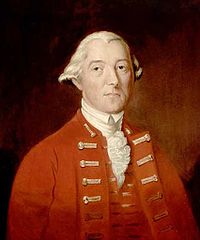
Many of the senior British officers in North America refused to comply with commodity 7. The British general Sir Guy Carleton (after Lord Dorchester), who allowable in New York Urban center, believed that any black American who had served the mother country was not property; he (and his family) were British subjects. In disobedience of the patently language of the treaty, (and of his ain political masters in London), he began to consequence passes which allowed the blackness bearer to go to Nova Scotia, or wherever else the freed black thought proper.[77] In May, 1783, George Washington met with Carleton. Washington protested near the British policy of conveying escaped slaves away. Carleton told Washington that the British were compiling a listing of all the blacks who were being helped to escape, chosen the Volume of Negroes.[78] A contemporary account states that "Sir Guy Carleton observed that no estimation could be put upon the article [commodity 7 of the peace treaty] inconsistent with prior [promises] binding the National Laurels which must be kept with all colors", and Carleton rebuked Washington for the suggestion that a British officer would consent to a "notorious breach of the public religion towards people of whatever complexion".[79] One black Loyalist who was somewhen evacuated by Carleton had belonged to Thomas Jefferson, and three to George Washington.[80]
Eventually, nigh three 1000 ex-slaves were evacuated past Carleton to Nova Scotia. One of their leaders there was Colonel Stephen Blucke, commander of the Black Brigade after Colonel Tye's death. Some somewhen went on to Sierra Leone. Boston King and his wife were among them. Many remained in Nova Scotia.[81]
Nor were Carleton's evacuees from New York Metropolis the only blackness Loyalists to escape from the United States. Thousands of other blacks escaped to Canada past other ways, many on ships leaving Charleston or Savannah. Others escaped to British Florida. A total of between xc-one hundred and x g four hundred black Loyalists eventually found refuge in Canada.[82]
The fate of the Loyalists [edit]

"Tory Refugees on their style to Canada" by Howard Pyle
The majority of the 400,000 to 500,000 Loyalists remained in the United States after the British left. Those who were in Loyalist gainsay units, and not-combatant Loyalist families who had very visibly aided the British crusade, and/or were unshakably loyal to United kingdom of great britain and northern ireland, generally left. The largest number became the foundation of the English-speaking Canadian community.[83] According to recent estimates, about 62,000 Loyalists at a minimum left the The states by 1784: 46,000 to Canada, 8000-x,000 to Keen Great britain and the residue to the Caribbean. five,090 whites and eight,385 blacks went to Florida, but almost all moved on later on it was returned to Spain in 1784: 421 whites and 2,561 blacks returned to us.[84]
The greater part of Loyalist emigration to Canada went to Nova Scotia and New Brunswick. There were at least two waves of American immigration shortly subsequently the Revolution to what is now Ontario, then Upper Canada. The start wave were the wartime Loyalists, who in the early on 1780s, went to the southern and eastern parts of the Niagara Peninsula. (Others went to the Eastern Townships in Quebec.) The emigrants to Ontario numbered approximately 6,600, not counting the Native American Iroquois. Small numbers of dedicated "Tories" continued to arrive in Upper Canada during the 1780s either as individual families or in small groups from the Mid-Atlantic States. In the second wave, 30,000 Americans, attracted by promises of land and low taxes in commutation for swearing allegiance to the King, went in the 1790s to the western Niagara Peninsula. Referring to this later on group of country-seeking immigrants, Canadian historian Fred Landon concludes that, "Western Ontario received far more land-seekers than Loyalists."[85] Even so, the kickoff wave, the defended Loyalist soldiers and families who came presently after the Revolution, had a much greater influence on the political and social development of Ontario.
As to the Loyalists who went to England, their story was sometimes non as happy as they had no dubiety dreamed. "Transplanted Americans were treated as Americans, non quondam or new Britons," and, "Some wealthy Loyalists chose exile in England, though they knew Loyalists were not welcome there."[86]
As to the Loyalists who remained inside the United States, Loyalists were a minority in every state and in most communities. This differentiated them from the assertive, vocal, white pro-Confederate majorities in the Southward after the Ceremonious War, who proudly proclaimed their Amalgamated heritage. Later on the Revolution, Loyalists and their descendants, prudently, rarely drew attending to themselves. An instance of some who did is the Tiffany family, originally of Connecticut, who donated the diary of a Loyalist antecedent to the Library of Congress in 2000. The diary indicated that in fact the Patriot hero Nathan Unhurt was captured past Robert Rogers and his Loyalists, a narrative not known before. [87]
Remaining in the Us after the Revolution, or leaving and later on returning, were not options for some of the Loyalists. Those who had fought for, or supported, the King sometimes rejected the new republic. The figure of a minimum of 62,000 Loyalist emigrants is given above. Some other, college, estimate is given in an American work dated 2022, which states that about one hundred thou Loyalists were evacuated, most of them to Canada.[88] The numbers of those who left, and who stayed abroad, are debatable. For more than information on this topic, see Loyalist (American Revolution), United Empire Loyalist, and Expulsion of the Loyalists.
In Canada, Loyalists of each regiment were usually given land in the same surface area then that soldiers who fought together could remain together. Allocations also depended on the Canadian port at which a regiment arrived. Thus, the King's Royal Regiment of New York, Butler'south Rangers, Jessup's Corps, the King's Rangers and Joseph Brant'due south Iroquois got land in what is now Ontario; part of De Lancey'south Brigade, the Pennsylvania Loyalists, the Rex's American Dragoons, the New Jersey Volunteers, the Royal Fencible Americans, the King'south Orange Rangers and others were given state in what is at present New Brunswick. Other Loyalists settled in Nova Scotia and Quebec.[89]
The defeated Tories of the Revolution became the United Empire Loyalists of Canada, the first big-calibration grouping of English-speaking immigrants to many parts of that country, and one which did much to shape Canadian institutions and the Canadian character.
Loyalists became leaders in the new English-speaking Canadian colonies. John Graves Simcoe, commander of the Queen'due south Rangers, became the Lieutenant Governor of Upper Canada (Ontario), and the city of Brantford, Ontario is named for the Loyalist Indian leader Joseph Brant. There is a bosom of John Butler of Butler'due south Rangers at the Valiants Memorial in Ottawa.
The pro-Loyalist tradition in Canada has been summed up by an American historian: "Many Canadians believe that their nation'south traditional devotion to law and civility, the very essence of being a Canadian, traces back to being loyal, equally in Loyalist." [90] This Canadian cocky-prototype is reflected in the British North America Act, (1867), the founding Canadian constitutional document, which defines the aims of the new Dominion equally "peace, social club and skillful government"--contrast with "life, liberty and the pursuit of happiness."
eight-x,000 Loyalists went to England, including hundreds of erstwhile slaves and Anglican clergy.[91] Eventually most 25% returned over the following decades.
Popular civilisation [edit]
By the fourth dimension of the Civil War, American popular hostility to the Loyalists was fading, to exist replaced by a vague retentivity of a few malcontents who for some reason could not accept the Revolution. Still Loyalists appear in American popular culture. In Stephen Vincent Benet's curt story "The Devil and Daniel Webster", Webster in his quarrel with the devil demands "an American jury", and gets one containing the Loyalist officer Walter Butler.[ farther caption needed ] In the book and film Drums Along the Mohawk, Loyalists are shown looting and burning with their Indian allies. The Disney telly serial The Swamp Fox (about the Patriot leader Francis Marion) showed Loyalists equally cowardly guns-for-rent and was condemned by the Canadian House of Commons. The 1985 Al Pacino film Revolution depicts a rich Loyalist family named the McConnahays, whose youthful daughter falls for Pacino and the Patriot cause. The film The Patriot has a British grapheme, Tavington, based on Banastre Tarleton. In history, Tarleton's men were mostly Loyalists. In the pic, 1, Captain Wilkins, is given a run a risk to declare his British allegiance at the kickoff of the pic, and is seen helping Cornwallis to the stop.
The novel Oliver Wiswell, by the American historical novelist Kenneth Roberts, tells the whole story of the Revolution from the Loyalist side. Roberts did non portray his Loyalist hero as eventually seeing the mistake of his ways and returning to the American fold. Instead, the book depicts Oliver Wiswell from his new home in Canada (which he calls "land of freedom") every bit still being hostile to the revolution and its leaders. Another American historical novelist, Bruce Lancaster, also depicted Loyalists, although from a more conventional condemnatory point of view.
Two novels at least deal with the story of the black Loyalists. One is Washington and Caesar by Christian Cameron, which tells the story of a black Loyalist fighting in the British forces. The Canadian novel The Book of Negroes, by Lawrence Colina, depicts an enslaved black woman who helps the British and escapes with their help.
See also [edit]
- List of British units in the American Revolutionary War
References [edit]
- ^ Middlekauff, Robert, The Glorious Cause: The American Revolution, 1763-1789, Oxford University Printing, 1982, pp. 549-550
- ^ Leonard Forest Labaree, Conservatism in Early American History (1948).
- ^ Ellis, Joseph J., American Cosmos: Triumph and Tragedies at the Founding of the Republic, Vintage Books, 2007, p. 75
- ^ Thomas B. Allen, Tories Fighting for the Rex in America`s Outset Civil War Harper, 2022, pp. 19-20; pp. 34-36
- ^ Allen, p. 61; p. 74
- ^ Allen, pp. 100-102
- ^ Allen, pp.106-108
- ^ Smith, Page, A New Age At present Begins A People'southward History of the American Revolution (Vol. One), McGraw-Colina, 1976, pp. 624-625
- ^ George C. Daughan (2016). Revolution on the Hudson: New York City and the Hudson River Valley in the American War of Independence. Westward. W. Norton. pp. 84–85.
- ^ Allen, pp. 157-183
- ^ Allen, pp. 184-208
- ^ Allen, pp.214-221
- ^ Smith, Page, A New Historic period At present Begins A People's History of the American Revolution (Vol. Two), McGraw-Loma, 1976, pp. 891-912
- ^ Smith, (Vol. Two), pp. 915-919
- ^ Allen, pp. 229-230
- ^ Allen, pp. 230-234
- ^ Allen, p. 252
- ^ Allen, pp. 252-255
- ^ Smith, (Vol. Two), pp. 1150-1158
- ^ Smith, (Vol. Two), pp. 1159-1162
- ^ Smith, (Vol. Two), p. 1163
- ^ Allen, p. 264
- ^ Allen, p. 235-251
- ^ Middlekauff, pp. 434-435
- ^ Allen, pp. 278-279
- ^ Smith, (Vol. Two), pp. 1309-1311
- ^ Middlekauff, pp. 448-449
- ^ Allen, p. 281
- ^ Allen, pp. 281-287
- ^ Smith, (Vol. Two), pp. 1399-1404; p. 1485
- ^ Middlekauff, pp. 454-457
- ^ Smith, (Vol. Two), pp-1404-1405
- ^ Smith, (Vol. Two), pp.1423-1424
- ^ Smith, (Vol. Two), pp. 1178-1182
- ^ Encounter Watt, Gavin K., The Burning of the Valleys Daring Raids From Canada Against the New York Frontier in the Fall of 1780, Dundurn Press, 1997
- ^ Smith, (Vol. Two), pp. 1184-1189
- ^ Smith, (Vol. 2), pp.1419-1420
- ^ Smith, (Vol. 2), pp. 1419-1434
- ^ Middlekauff, pp. 470-476
- ^ Smith, (Vol. Two), pp. 1470-1472
- ^ Smith (Vol. Two), p. 1492
- ^ Smith (Vol. Two), pp. 1486-1495
- ^ Smith (Vol. Two), pp. 1502-1506
- ^ Middlekauff, pp 493-495
- ^ Smith, (Vol. 2), p. 1507
- ^ Smith, (Vol. Ii), pp. 1631-1633
- ^ Allen, pp. 302-306
- ^ Allen, p. 295
- ^ Allen, pp. 307-320
- ^ Smith (Vol. Two), p. 1750
- ^ "To George Washington from Non Assigned, 1 May 1782 (Early on Access Document)". The Papers of George Washington. Founders Online. ane May 1782. Archived from the original on five June 2022.
- ^ "Perfidious America". The Economist. xx December 2022. pp. 64–66. Retrieved viii February 2022.
Accounts of his decease differ: his brother Aaron, captured with him, signed an affidavit attesting that he was killed while trying to escape. Aaron later recanted, challenge that his captors had threatened to impale him unless he signed; the truth, he now maintained, was that the American militiamen had executed Philip White in cold blood.
- ^ Allen, pp. 320-321
- ^ For a full business relationship, see Gilbert, Alan, Black Patriots and Loyalists Fighting For Emancipation in the War For Independence, University of Chicago Printing, 2022
- ^ Gilbert, p. 6
- ^ Zinn, Howard, A People's History of the United States, Harper Perennial Modern Classics, 2005, p. 88
- ^ Gilbert, p. xi
- ^ Allen, p. 155
- ^ Allen, pp. 154-155
- ^ Allen, pp.172-173
- ^ Gilbert, pp. 39-45
- ^ Gilbert, p. 29
- ^ Gilbert, p. xii
- ^ Gilbert, p. ix
- ^ Gilbert, p. 261
- ^ Gilbert, pp. 122-127
- ^ Allen, pp. 315-317
- ^ Gilbert, p. 147
- ^ Smith, (Vol. Two), p. 1393
- ^ Smith, (Vol. Two), p. 1394
- ^ Gilbert, p. 154
- ^ Allen, pp. 154-155
- ^ Smith, (Vol. Ii), p. 1399
- ^ Smith, (Vol. Two), p. 1393
- ^ Smith, (Vol. Two), p. 1330
- ^ Allen, pp. 330-331
- ^ Allen, p. 331
- ^ Allen, pp. 331-332
- ^ Gilbert, pp. 177-178
- ^ Allen, p. 332
- ^ Allen, pp. 330-333
- ^ Gilbert, pp. 190-205
- ^ Maya Jasanoff, Liberty's Exiles: American Loyalists in the Revolutionary Globe (2011).
- ^ Russell, David Lee (2000). The American Revolution in the Southern colonies. McFarland & Co. p. 317. ISBN0-7864-0783-2.
- ^ Fred Landon, Western Ontario and the American borderland (1941) p 280.
- ^ Allen, Thomas B. (2011). Tories : fighting for the King in America's commencement civil war (1st Harper pbk ed.). Harper. p. 328. ISBN978-0061241819.
- ^ Allen, p. 175
- ^ Allen, p. 333
- ^ D.G.K. Kerr, ed., A Historical Atlas of Canada ( Thomas Nelson and Sons, 1966), pp. 36-37
- ^ Allen, p. 333
- ^ Keith A. Sandiford. Measuring the Moment: Strategies of Protest in Eighteenth-century Afro-English Writing (Susquehanna University Press, 1988), p 24.
External links [edit]
- Listing of Loyalist Regiments - The On-Line Institute for Advanced Loyalist Studies
- United Empire Loyalists' Association of Canada (UELAC)

Source: https://en.wikipedia.org/wiki/Loyalists_fighting_in_the_American_Revolution
Posted by: catalanoource1962.blogspot.com
0 Response to "How To Draw Patriots From The American War"
Post a Comment