

How To Draw A Fibonacci Technical Analysis
If you are an agile solar day trader, yous are probably aware that Fibonacci retracement and extension levels are some of the most important and useful tools in all of cost action.
Twenty-four hour period traders and technical analysts can use Fibonacci levels analysis to confirm an entry-level, target a take profit, and to decide your stop loss level.
In this guide we will explain exactly how to draw Fibonacci levels, and so that you can make better decisions about when to get in and out of trades.
What are Fibonacci numbers and ratios?
Fibonacci sequence, also sometimes referred to as The Golden Ratio, is a series of numbers where each number is a sum of the previous ii numbers.
For example, with the string 0, ane, ane, two, 3, v, 8, 13, 21, 34, 55, if nosotros add 0+1, we get 1. If we add 1+ane, we get 2. If we add ane+2, we get 3, and so on forever down the sequence.
The resulting sequence is known as the Fibonacci sequence and each of number in the sequence is chosen a Fibonacci number. The Fibonacci ratios are then calculated by dividing numbers across the sequence. These calculations then give us the post-obit ratios that are used in the Fibonacci levels.
0, 0.236, 0.382, 0.v, 0.618, 0.786, i, i.618, ii.618
The ratios become translated into percentages – 23.6%, 38.2%, 61.8%, 78.6%, etc. – which are then applied to the nautical chart to try and identify potential hidden support or resistance levels in the market.
The Fibonacci sequence was discovered in 1202 by an Italian mathematician known as Leonardo of Pisa, while considering a practical problem involving the growth of a hypothetical population of rabbits based on idealized assumptions.
This sequence governs many aspects of life; from the cosmos of flowers, the germination of waves, to proportioning of the human body. It besides provides the data that traders and technical analysts need to formulate resistance and support levels which can exist used within a gamble management framework.
You can utilize Fibonacci retracement levels on their own or combine them with other trading methodologies.
The Fibonacci sequences were used to codify other theories such equally the Elliot Wave Principle and Dow Theory. You can likewise use Fibonacci ratios with other technical analysis tools.
How Fibonacci retracement levels are calculated
One of the most common technical assay tool derived from the Fibonacci gold ratios are the Fibonacci retracement levels.
The 61.8% Fibonacci ratio and the 32.8% Fibonacci ratio are calculated by subtracting the recent high from the recent low and targeting the impending rebound. Near of these points are can be calculated using charting software.
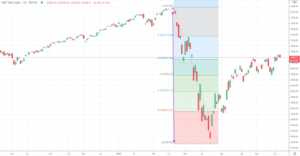
The Fibonacci Retracement levels commonly behave like magnets creating a self-fulfilling prophecy as bear witness in the Southward&P 500 index chart above.
Equally y'all can meet from the chart, the realization that the coronavirus pandemic would batter the U.Southward. economy triggered an instant deport market starting in February and reached a bottom in March. Prices fell from most three,400 to 2,200 and then bounced back to the 38.2% retracement level.
If we take the refuse and multiply information technology by 38.ii% and then add together that figure to the low (2,200), we would become the 38.2% Fibonacci retracement level, which is ii,647. The index began to consolidate at this betoken.
Subsequently the consolidation flow, prices retested the 38.ii% retracement level and broke to the next level which was the 50% retracement. The consolidation was brief. The S&P 500 index then moved to test the 61.8% retracement level and has consolidated around that region.
When you draw Fibonacci retracement lines, you will measure the peak to trough of the move that you are targeting. The deviation between the high and the low is then multiplied by 61.eight% and 38.2%.
These results are added to the depression if you are measuring a drop, or subtracted from the high if you are measuring a rising. These levels will become your target support during a correction or resistance as the toll is rebounding.
How to draw Fibonacci levels on a chart for trading decisions
Fibonacci retracements
The Fibonacci retracement tool is designed to assist traders know where and when a retracement will stop. This tool similar to support and resistance because it marks levels where the toll of a security might reverse during a retracement. Just the main difference is it does this automatically, through the use of a tool, instead of you lot placing the levels manually. And then, how can yous describe information technology on a chart?
Drawing Fibonacci retracements in an uptrend
The first affair yous need to practice is to examine the almost recent price action and identify a significant swing high and swing low.
After you locating these two points on the chart, select the swing low and drag the cursor to the swing high point. You tin can and then use the 2 reference points every bit the basis for the Fibonacci levels that will then be plotted automatically on the chart.
Drawing Fibonacci retracements in a downtrend
To plot Fibonacci retracement levels in a downtrend in a downwards trending market condition, you need to select the well-nigh recent pregnant swing high and depression points.
Start with the swing loftier point, so drag the cursor down to the swing depression bespeak. After selecting these two points, your Fibonacci retracement tool will then automatically generate the relevant Fibonacci levels.
Fibonacci extensions
Fibonacci extensions merely refers to levels that go beyond the 100% level. These levels work just the aforementioned as retracement levels, but chartists only utilize them to map out how future swings are likely to happen rather than retracements.
Fibonacci extensions likewise follow the aforementioned number sequence; 23.60%, 38.20%, 50%, and so on. Notwithstanding, they all have a one in front – so 38.twenty% is 382.00% – since they announced past 100% of the swing rather than within.
Drawing Fibonacci extensions
When drawing Fibonacci extensions, the first thing yous need to do is to find a trend or swing you want to employ as a base. And so, find and select 2 swing points, and stretch the Fibonacci extensions tool between the two edges of that swing.
If you are measuring a bullish swing, you need to stretch the indicator beginning from the lowest to the highest point of the swing. On the other mitt, if you are measuring a surly swing, then you stretch the tool starting from the top to the bottom of the down motility.
Basically, the idea is to have the 0.00% level at the end of the swing that you take as a base. Once you stretch the tool, the Fibonacci extension levels will be plotted automatically on the chart.
Bottom Line
Learning to merchandise the market using Fibonacci levels is not really difficult.
They are one of the about useful technical assay tools that yous tin can employ to mean solar day trade stocks and other fiscal securities.
Traders mainly use Fibonacci levels to identify resistance and back up levels. When a stock is in an uptrend or downtrend, information technology normally makes a slight pull back earlier continuing the trend.
Ofttimes, the stock will retrace to a key Fibonacci retracement level like 61.8% or 38.two%. These levels offer signals for traders to get into new positions in the direction of the original trend.
If the stock is in an uptrend, yous might look to buy on a retracement down to a key back up level. If the stock is in a downtrend, you could sell when it retraces up to its key resistance level. Merely put, the Fibonacci levels work best when a stock is in an uptrend or downtrend.

Source: https://www.warriortrading.com/how-to-draw-fibonacci-levels/
Posted by: catalanoource1962.blogspot.com
0 Response to "How To Draw A Fibonacci Technical Analysis"
Post a Comment