

Working With The Properties Of Mathematics Worksheet Answer Key
Basic Number Properties
The ideas behind the basic properties of real numbers are rather simple. You may even think of it as "common sense" math because no complex analysis is really required. There are four (4) basic properties of real numbers: namely; commutative, associative, distributive and identity. These properties only apply to the operations of addition and multiplication. That means subtraction and division do not have these properties built in.
I. Commutative Property
For Addition
The sum of two or more real numbers is always the same regardless of the order in which they are added. In other words, real numbers can be added in any order because the sum remains the same.
Examples:
a)a + b = b + a
b)5 + 7 = 7 + 5
c) {}^ - 4 + 3 = 3 + {}^ - 4
d)1 + 2 + 3 = 3 + 2 + 1
For Multiplication
The product of two or more real numbers is not affected by the order in which they are being multiplied. In other words, real numbers can be multiplied in any order because the product remains the same.
Examples:
a) a \times b = b \times a
b)9 \times 2 = 2 \times 9
c)\left( { - 1} \right)\left( 5 \right) = \left( 5 \right)\left( { - 1} \right)
d) m \times {}^ - 7 = {}^ - 7 \times m
II. Associative Property
For Addition
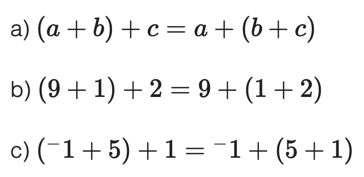
The sum of two or more real numbers is always the same regardless of how you group them. When you add real numbers, any change in their grouping does not affect the sum.
Examples:
For Multiplication
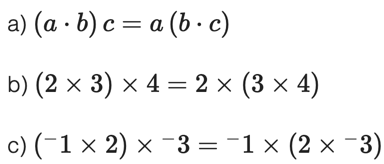
The product of two or more real numbers is always the same regardless of how you group them. When you multiply real numbers, any change in their grouping does not affect the product.
Examples:
III. Identity Property
For Addition
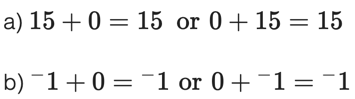
Any real number added to zero (0) is equal to the number itself. Zero is the additive identity since a + 0 = a or 0 + a = a. You must show that it works both ways!
Examples:
For Multiplication
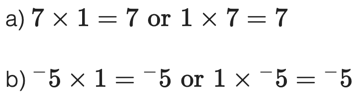
Any real number multiplied to one (1) is equal to the number itself. The number one is the multiplicative identity since a \times 1 = a or 1 \times a = 1. You must show that it works both ways!
Examples:
IV. Distributive Property of Multiplication over Addition
Multiplication distributes over Addition
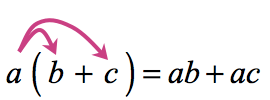
Multiplying a factor to a group of real numbers that are being added together is equal to the sum of the products of the factor and each addend in the parenthesis.
In other words, adding two or more real numbers and multiplying it to an outside number is the same as multiplying the outside number to every number inside the parenthesis, then adding their products.
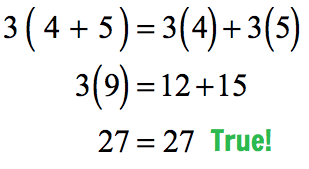
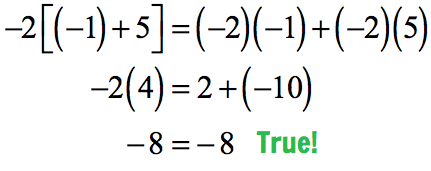
Examples:
a)
b)
c)
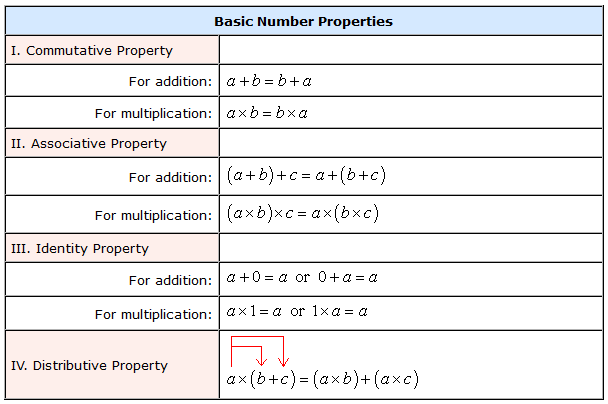
The following is the summary of the properties of real numbers discussed above:
Why Subtraction and Division are not Commutative
Maybe you have wondered why the operations of subtraction and division are not included in the discussion. The best way to explain this is to show some examples of why these two operations fail at meeting the requirements of being commutative.
If we assume that Commutative Property works with subtraction and division, that means that changing the order doesn't affect the final outcome or result.
"Commutative Property for Subtraction"
Does the property a - b = b - a hold?
a)
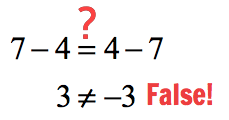
b)
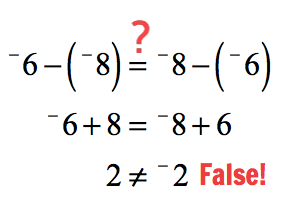
Since we have different values when swapping numbers during subtraction, this implies that the commutative property doesn't apply to subtraction.
"Commutative Property for Division"
Does the property a \div b = b \div a hold ?
a)
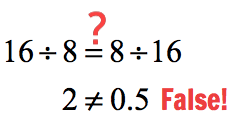
b)
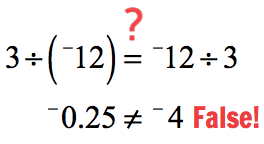
Just like in subtraction, changing the order of the numbers in division gives different answers. Therefore, the commutative property doesn't apply to division.
Why Subtraction and Division are not Associative
If we want Associative Property to work with subtraction and division, changing the way on how we group the numbers should not affect the result.
"Associative Property for Subtraction"
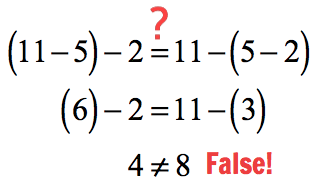
Does the problem \left( {a - b} \right) - c = a - \left( {b - c} \right) hold?
a)
b)
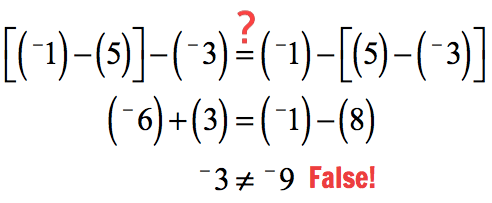
These examples clearly show that changing the grouping of numbers in subtraction yield different answers. Thus, associativity is not a property of subtraction.
"Associative Property for Division"
Does the property \left( {a \div b} \right) \div c = a \div \left( {b \div c} \right) hold?
a)
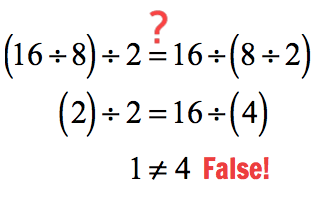
I hope this single example seals the deal that changing how you group numbers when dividing indeed affect the outcome. Therefore, associativity is not a property of division.
Working With The Properties Of Mathematics Worksheet Answer Key
Source: https://www.chilimath.com/lessons/introductory-algebra/basic-number-properties/
Posted by: catalanoource1962.blogspot.com
0 Response to "Working With The Properties Of Mathematics Worksheet Answer Key"
Post a Comment